Adventure Medics teaches the Prehospital Ultrasound Academy in Bend, Oregon — a three-day, hands-on point-of-care ultrasound course built for EMS providers who need to acquire and interpret images in the back of a rig, on a scene or in the backcountry, not in a hospital bay. It helps rapidly identify life-threatening conditions like internal bleeding, pneumothorax, or cardiac arrest causes, guiding immediate field treatments and hospital destination choices. Didactic instruction, scanning stations and simulation across pulmonary, focused cardiac, carotid and eFAST ultrasound, taught by Drew Congdon, BASc, FP-C, CCP-C.
Next Academy: October 26–28, 2026
Lava Rock Ranch · 64395 Deschutes Market Road, Bend, OR 97701 · 3 days, 9:00 AM – 5:00 PM daily
A $100 deposit holds your seat; the balance is due once the class reaches minimum enrollment. Central Oregon EMS and medical providers: email us for a discount code that saves over $100. Seats are limited — see all upcoming dates on our class schedule.
What the Prehospital Ultrasound Academy covers
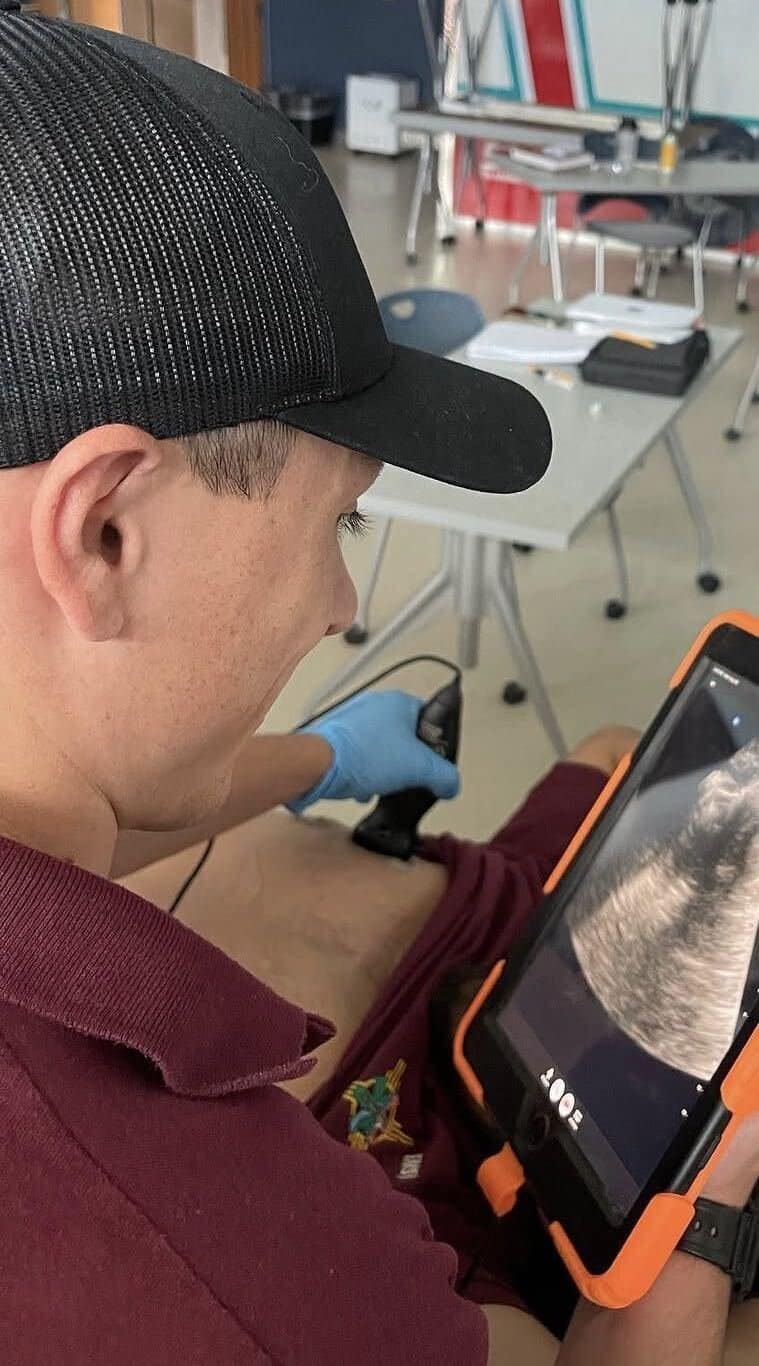
This course prepares prehospital providers to integrate point-of-care ultrasound into their EMS system: how the machine makes an image, how to get a usable window on a moving patient, what the image is telling you, and what you do differently because of it. Roughly the entire course is hands on — scanning stations with instructor coaching, image interpretation exercises and simulation-based scenarios, with emphasis on clinical integration, quality assurance and the evidence-based use of ultrasound findings in patient assessment, treatment decisions, resuscitation strategy and destination planning.
- Ultrasound Physics and Image Acquisition
- Pulmonary Ultrasound Assessment
- Focused Cardiac and Carotid Ultrasound Assessment
- Ultrasound-Guided Cardiac Arrest Assessment
- Trauma Ultrasound and the eFAST Examination
- Clinical Integration and Decision-Making
- Quality Assurance and Program Implementation
Three-day course schedule
Day 1
Ultrasound physics · image orientation · basic anatomy identification · pulmonary ultrasound: normal lung anatomy, lung sliding and pneumothorax, pulmonary edema and B-lines, pleural effusion, consolidations. Simulation: image acquisition practice and undifferentiated respiratory distress.
Day 2
Focused cardiac assessment · cardiac ultrasound views · cardiac anatomy · carotid assessment during cardiac arrest. Simulation: cardiac arrest and cardiovascular emergency scenarios.
Day 3
Trauma assessment · the eFAST exam · hemoperitoneum · pericardial tamponade · hemothorax · pelvic ultrasound, then final written and practical assessments. Simulation: trauma and trauma-arrest scenarios.
The Academy was formerly a five-day course; the same content is now covered in three days. You can read the full course syllabus, including medical director and agency approval sections.
Minimum scan requirements
You leave with documented reps, not just lecture notes. Every student completes and documents the following minimum number of supervised ultrasound examinations during the course, and must demonstrate image-acquisition proficiency as determined by course faculty and the Medical Director.
| Examination | Minimum number |
|---|---|
| Pulmonary ultrasound | 20 |
| Focused cardiac ultrasound | 20 |
| eFAST examinations | 10 |
| Carotid pulse Doppler / cardiac arrest assessment | 5 |
Learning objectives
On successful completion of the Academy, participants will be able to:
- Explain ultrasound physics, image generation, probe selection and machine operation relevant to prehospital care
- Set up and optimize an ultrasound system and acquire images using infection-control practices that work out of hospital
- Identify normal sonographic anatomy of the thorax, heart, abdomen, pelvis and major vascular structures commonly assessed in EMS
- Acquire and interpret lung views for lung sliding, B-lines, pleural effusion, pneumothorax and consolidation
- Obtain standard focused cardiac views and recognize pericardial effusion, tamponade, right ventricular strain, gross left ventricular dysfunction and cardiac standstill
- Perform carotid ultrasound and carotid pulse Doppler assessment during cardiac arrest resuscitation
- Perform a complete eFAST examination and recognize free intraperitoneal fluid, hemothorax, pneumothorax and pericardial effusion in trauma
- Integrate ultrasound findings with history, exam and physiologic data to support clinical decision-making and patient disposition
- Describe the indications, limitations and pitfalls of prehospital ultrasound, and when to seek physician consultation or further diagnostic evaluation
- Apply quality assurance principles, image documentation standards and the protocols needed to implement a prehospital ultrasound program
Assessment and course completion
Formative assessment runs daily: image acquisition practice with instructor feedback, simulation-based scenario assessment, image interpretation exercises and case-based debriefings. Summative assessment is a written examination covering ultrasound physics, image interpretation, clinical integration and the indications and limitations of prehospital ultrasound, plus a practical examination of pulmonary, focused cardiac, carotid pulse Doppler and eFAST examinations in scenario-based clinical integration. Successful completion requires a minimum score of 80% on both the written and practical examinations and demonstrated competency in pulmonary, cardiac, carotid and eFAST image acquisition and interpretation.
Equipment and materials
All ultrasound equipment, simulation equipment and training aids are provided, so you do not need to ship or borrow a machine to attend — scanning stations for this session are equipped with Clarius handheld scanners. Students may train on their own agency-issued ultrasound devices with instructor approval — worth doing if you are about to put those probes into service. All course reference materials are provided, and supplemental reading and image interpretation guides are distributed electronically.

Scanners provided by Clarius
Clarius is supporting the Academy with four handheld ultrasound scanners — two Clarius L15 and two Clarius PAL HD3 units, plus four iPads and scanner accessories. Students scan on current-generation wireless handheld hardware, so you do not need to ship or borrow a machine to attend.
Who should take this course
- Paramedics, critical care and flight crews adding point-of-care ultrasound
- EMS agencies standing up a new prehospital ultrasound program
- Search and rescue, wilderness and remote-duty medical providers
- Physicians, PAs, NPs and nurses working in prehospital or austere settings
- Medical directors and program directors evaluating POCUS for their system
Your instructor
The Academy is led by Drew Congdon, BASc, FP-C, CCP-C, a nationally recognized educator and pioneer in prehospital ultrasound education. The course reflects how ultrasound is actually used in the field — including the parts most hospital-based POCUS courses skip: scanning in poor light, on uneven ground, mid-resuscitation, and building the quality assurance and documentation structure an agency needs before it can run a program at all.
Where it happens, and getting to Bend
The Academy is held at Lava Rock Ranch, 64395 Deschutes Market Road, Bend, OR 97701, on the north side of Bend. Redmond Airport (RDM) is 15 minutes away and several car rental agencies operate from the terminal. Adventure Medics can provide a discounted rate at the Fairfield Inn Bend, and there are plenty of other lodging options in town. You can also stay on the ranch: tent and car camping is $20, and a full RV hookup is $45 per night. Tell us when you register so we can hold your spot and send arrival details.
Bringing ultrasound to your agency
If you are standing up a prehospital ultrasound program rather than adding a personal skill, the last block of the course is for you: quality assurance principles, image documentation standards and the system-specific protocols an agency needs in place. We also teach the Academy on site for agencies, fire departments and hospital systems — call (541) 639-9993 and ask for training, or email train@advmedics.com.
Frequently asked questions
What is the Prehospital Ultrasound Academy?
A three-day point-of-care ultrasound course for prehospital providers, taught by Adventure Medics at Lava Rock Ranch in Bend, Oregon. It combines didactic instruction, hands-on scanning stations and simulation across pulmonary, focused cardiac, carotid and eFAST/trauma ultrasound, plus clinical integration, quality assurance and program implementation.
How long is the course, and when is the next one?
Three consecutive days, 9:00 AM to 5:00 PM each day. The next Academy runs October 26–28, 2026 in Bend. It was formerly a five-day course; the same content is now covered in three days.
Who teaches it?
Drew Congdon, BASc, FP-C, CCP-C — a nationally recognized educator and early developer of prehospital ultrasound education.
How much does it cost?
$595 total, with a $100 deposit to hold your seat. When the class reaches its minimum enrollment you will be contacted to pay the balance. Central Oregon EMS and medical providers should email us for a discount code worth over $100.
Do I need to bring an ultrasound machine?
No. All ultrasound equipment, simulation equipment and training aids are provided. For the October 2026 Academy, Clarius is supplying four handheld scanners — two Clarius L15 and two Clarius PAL HD3 units with iPads and accessories. If you want to train on your own agency-issued device you may, with instructor approval — which is the best way to go home ready to scan on your rig.
Do I need prior ultrasound experience?
No prior scanning experience is assumed. The course starts at physics, probe selection and image orientation and builds from there, so both new and experienced scanners can work at their own level at the scanning stations.
How many scans will I actually perform?
Students complete and document a minimum of 20 pulmonary, 20 focused cardiac, 10 eFAST and 5 carotid pulse Doppler / cardiac arrest examinations under supervision, and must demonstrate image acquisition proficiency as determined by course faculty and the Medical Director.
How do I pass the course?
A minimum score of 80% on both the written and the practical examination, plus demonstrated competency in pulmonary, cardiac, carotid and eFAST image acquisition and interpretation.
Does the course carry CE, CEU or NREMT credit?
Contact us before you register and we will confirm what credit is available for your certification or licence. Call (541) 639-9993 or email train@advmedics.com.
Where do I stay, and can I camp on site?
Redmond Airport (RDM) is 15 minutes from Lava Rock Ranch and has several rental car agencies. We can provide a discounted rate at the Fairfield Inn Bend, or you can stay on the ranch: tent and car camping is $20, and a full RV hookup is $45 per night.
Can you bring this course to our agency?
Yes. We run the Academy on site for EMS agencies, fire departments, hospitals and programs anywhere in the region. Call (541) 639-9993 and ask for training, or email train@advmedics.com.
Register or ask us a question
Register for the October 26–28, 2026 Academy
Questions, group bookings or a custom on-site course: call (541) 639-9993 and ask for training, or email train@advmedics.com.
Other Adventure Medics courses, including our Wilderness First Responder course in Bend, are listed on the class schedule.