Adventure Medics runs critical care and long-distance interfacility transport across Oregon — CCT, ALS and BLS care, bedside to bedside. We always run with a CCT medic or nurse, along with a paramedic.
If emergency, call 911.
When to call us
- CCT / ALS / BLS transfers between facilities, across town or across the state
- Ventilated patients — Hamilton T1, protective lung strategies, BiPAP / CPAP
- Vasoactive drips and sedation packages on transport pumps
- Chest tubes, invasive hemodynamic monitoring, pediatric and adult airway with high-flow nasal cannula
- Time-sensitive emergencies — stroke, STEMI, urgent surgical intervention
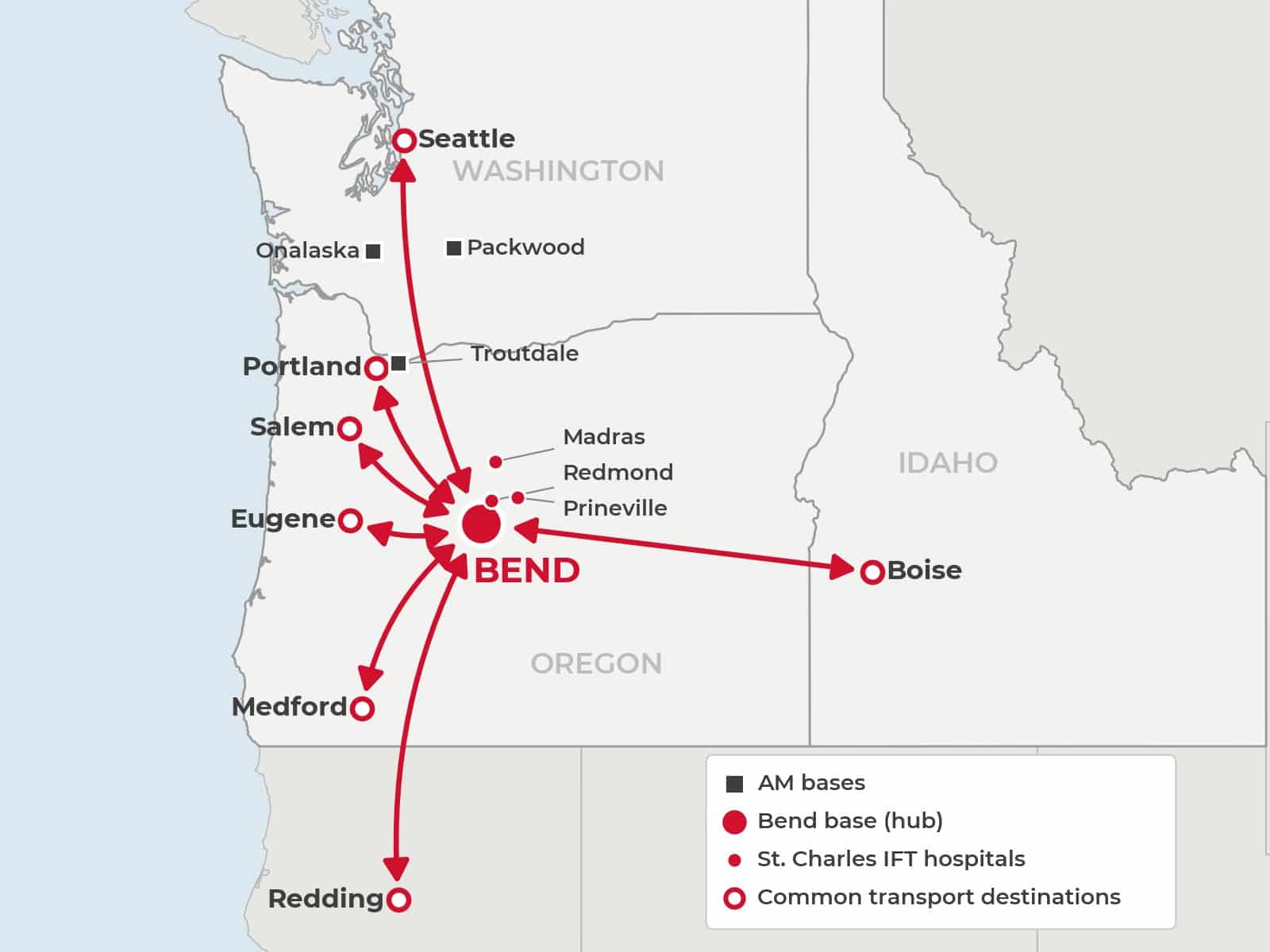
- Tertiary referrals to Portland, Seattle, Boise, Salt Lake City, Reno and beyond
- Repatriations and step-downs back to the patient’s home community
- Winter and mountain-pass runs other services turn down
Levels of transport we provide
| Level | Crew | Typical patient |
|---|---|---|
| Critical Care (CCT) | CCT medic (FP-C / CCP-C) or nurse + paramedic | Ventilated, multiple drips, invasive monitoring, chest tubes, high-acuity pediatrics |
| ALS | Paramedic + EMT | Cardiac monitoring, IV medications, airway risk |
| BLS | EMT crew | Medically stable, non-emergent stretcher transport with basic monitoring by two certified EMTs |
| Wheelchair / discharge | EMT-certified transport staff | Stable stretcher transfers, admissions, discharges and appointments |
The crew
We always run with a CCT medic or nurse, along with a paramedic
Certified critical care paramedics (FP-C / CCP-C) and registered nurses lead our critical care runs, each partnered with a paramedic.
Medical direction
Dr. Cornelius Peeples (Oregon) and Dr. Krista Caldwell (Washington).
A pathway, not a title
Our CCT medics complete a critical care boot camp, advanced certification and a proctored field training and evaluation program before they run solo. After that, training never stops: monthly continuing education, plus quarterly airway and clinical patient scenarios and drills.
What is on board
Ventilated patients
- Hamilton T1 transport ventilator
- Protective lung strategies
- BiPAP and CPAP
- EtCO₂ monitoring
Airway
- Pediatric and adult high-flow nasal cannula on every ambulance
- Video laryngoscope with recording
Cardiac monitoring
- Zoll X Series cardiac monitor
- 12-lead and pacing
- Cardioversion and defibrillation
- Invasive hemodynamic monitoring
- Non-invasive blood pressure and pulse oximetry
Perfusion
- Alaris and Sapphire infusion pumps
- Blood administration warmer
- Intravenous fluid warmer
Ultrasound and more
- Ultrasound for vascular access and fetal imaging
- Temperature monitoring
- Pediatric securing devices, Doppler, Stryker Power-PRO
Specialty transport
- Extra oxygen supply for long-distance runs
- Swan-Ganz (pulmonary artery catheter) monitoring
- Arterial line monitoring
- Central venous pressure (CVP) monitoring
- Intra-aortic balloon pump (IABP) transport
The fleet
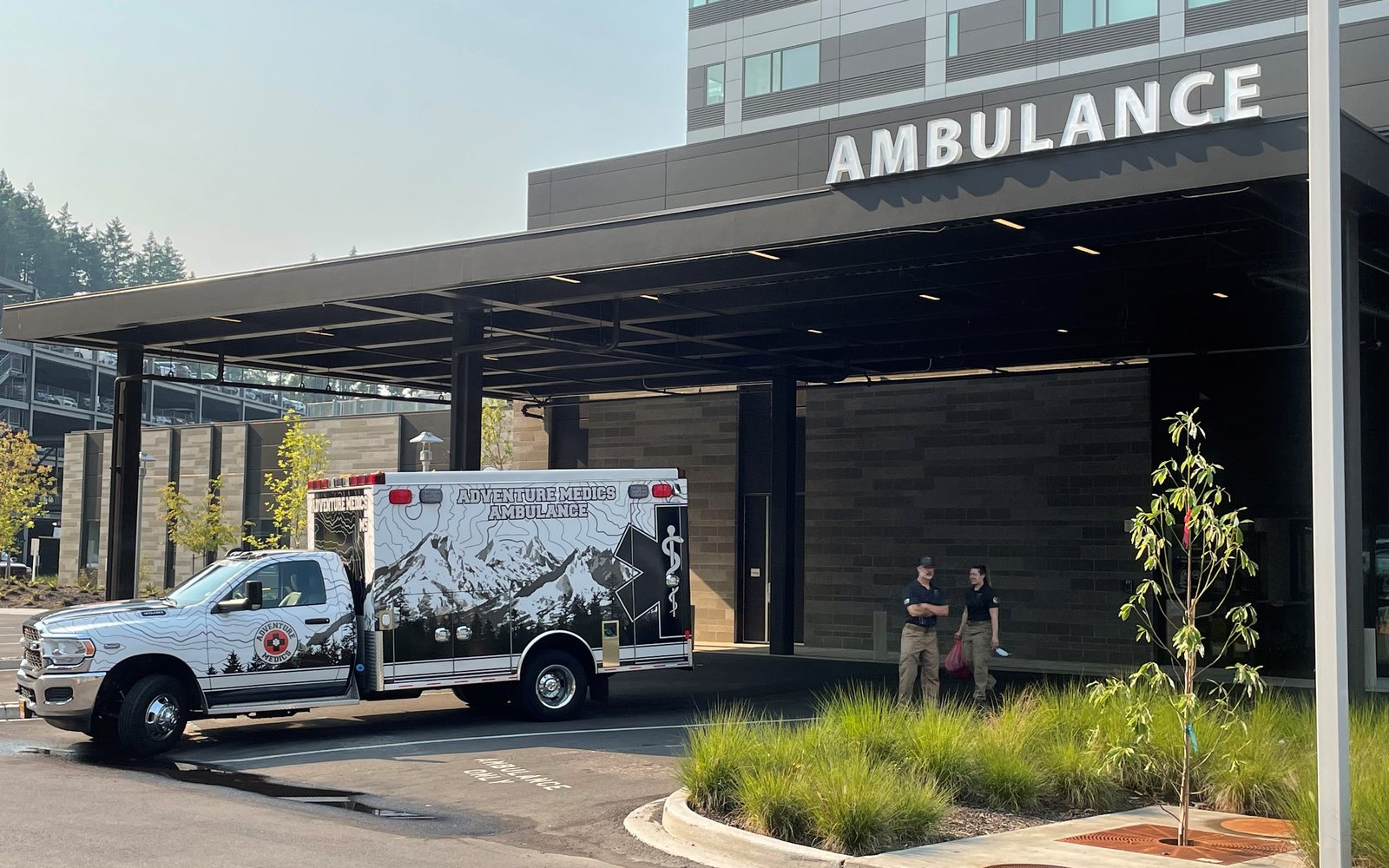
- A dedicated critical care ambulance, 24/7, plus two dedicated ALS/BLS ambulances staffed around the clock — a long-distance run does not strip your local coverage.
- 13 licensed ambulances. Type I modular ambulances on 4×4 chassis for pass-and-plateau mileage, plus Type II vans for scheduled long-distance and step-down moves.
- Staged across the region: Bend and Troutdale, Oregon · Onalaska and Packwood, Washington — so the truck starts closer to your dock.
How a transfer works
1Call us
One number, 24/7. Give us acuity, medications, origin and destination.
2We confirm the level
We tell you plainly what we can take and what we cannot.
3An ETA you can plan around
A realistic pickup window, a sub-10-minute wheels-up KPI goal and proactive updates if anything changes.
4Bedside to bedside
Patient report and documentation handed to receiving staff.
Request a transfer
Call dispatch at 833.423.8633, 24/7, for scheduled, next-day and emergent transfers. Have acuity, medications, origin and destination ready. If emergency, call 911.
Billing
Ambulance transports (BLS, ALS and critical care): Our billing partner, Systems Design West, bills the patient’s insurance — Medicare, Medicaid and commercial plans, including secondary coverage. Please send a face sheet and a signed Physician Certification Statement (medical necessity) with every transport.
Facility transports: Flexible. Depending on the patient, we invoice the facility directly (for example, campus-to-campus transfers) or bill insurance. We set this up with each facility in advance.
Dedicated coverage: Need regular local transfers in an area outside our bases? We can contract to station a crew for your facility, scoped to your transfer volume and levels of care.
Long-distance transports: Quoted at the time of request.
Discharges (wheelchair and stretcher): We contract directly with your facility — no brokers. The facility or the patient pays at our discharge rates; we do not bill Medicare or Medicaid for discharge trips, and we confirm the cost before the trip.
Service area
Based in Bend and Troutdale, Oregon and Onalaska and Packwood, Washington, we cover Central Oregon, the Columbia Gorge, the Portland metro area and Southwest Washington, with long-distance transports throughout the Pacific Northwest and the Intermountain West.
Set us up as a transport vendor
Want Adventure Medics on your facility’s approved transport vendor list? Send us your contact and we will get you everything your team needs.
Frequently asked questions
What level of care does a critical care transport include?
Every Adventure Medics critical care transport is staffed by a certified critical care paramedic or a registered nurse, along with a paramedic, with ventilator management, vasoactive infusions, sedation, invasive hemodynamic monitoring, blood administration and point-of-care ultrasound available in the truck.
How far will you transport a patient?
There is no mileage ceiling. We routinely run long-distance transports from Central Oregon and Southwest Washington to tertiary centers in Portland, Seattle, Boise, Salt Lake City and Reno, and we bring patients home again after their care is complete.
How does ground critical care transport compare to flight?
Flight is the right call when minutes matter most over long distances, and we will tell you when it is. For most interfacility transfers, ground critical care compares well:
- Weather: aircraft are grounded by icing, low ceilings, wind and smoke. Our Type I ambulances on 4×4 chassis run through the winter passes, so a ground launch is far less likely to be delayed or cancelled.
- Launch readiness and dispatch time: flight programs complete pre-flight checks before every launch. We check our ambulance, equipment and supplies once at the start of every shift, so the crew is ready to roll the moment a transfer is accepted — for faster dispatch times.
- Cost: ground critical care typically costs a fraction of an air ambulance transport, for the patient, the payer and the hospital.
- Altitude: there is no cabin pressurization or rapid climb. Patients stay near road elevation, which limits gas expansion, oxygen demand and pressure-related complications.
- Handoff quality: the same crew goes bedside to bedside. Fixed-wing transfers add a ground ambulance at each end, which means more handoffs and more moves of lines, tubes and pumps.
- Space and capacity: more room to work on the patient, extra oxygen for long runs, and space for a family member when appropriate.
Are you licensed for critical care transport?
Yes — Adventure Medics is licensed and approved for critical care transport in both Oregon and Washington, under the medical direction of Dr. Cornelius Peeples (Oregon) and Dr. Krista Caldwell (Washington).
What if I am not sure which level of transport my patient needs?
Call us. We will work through acuity and medications with you and tell you plainly what level is appropriate — including when a lower level is the right answer.
How quickly can you respond?
We staff a dedicated critical care ground ambulance around the clock and give you a realistic pickup window when you call, rather than an optimistic one.
If emergency, call 911.